Public criticism is mounting internationally after a controversial statement by Donald Trump amid the ongoing Middle East conflict involving Iran and regional neighbors.
Rising violence and diplomatic tension continue to unsettle global leaders and markets. The situation began in late February 2026 when coordinated military strikes by the United States and Israel targeted Iranian military and strategic sites.
This campaign, widely referred to as part of the “Iran war,” has rapidly escalated violence across the Persian Gulf. Iran has retaliated repeatedly, using missiles and drones against U.S. and allied targets, including airbases in the region. Reports indicate ongoing attacks on strategic locations in Bahrain, Kuwait, and other Gulf states.
In recent days, Iran reportedly launched ballistic missile salvos toward Jerusalem and northern Israel, triggering air raid sirens and raising fears of wider conflict escalation along multiple fronts.
The conflict’s energy dimension intensified when an Israeli strike hit Iran’s South Pars gas field, part of the world’s largest natural gas reserve. The attack significantly damaged production and sparked retaliation against Qatar’s Ras Laffan LNG processing complex.
South Pars fuels a large share of Iran’s domestic energy and export capacity. Damage to this field has disrupted supply chains and contributed to volatility in global oil and gas markets, with prices fluctuating sharply.
In response to the escalation, energy facilities throughout the Gulf region—especially in Kuwait and Saudi Arabia—have reportedly been targeted by Iranian drone strikes, though many were intercepted by defense systems.
Air raid sirens also sounded in the United Arab Emirates and Bahrain, underscoring how broadly the conflict has spread beyond Iran and Israel’s immediate border zones.
Amid these dramatic developments, Donald Trump has been posting frequent and highly visible messages on his social platform, Truth Social, commenting on every major development related to the conflict with Iran.
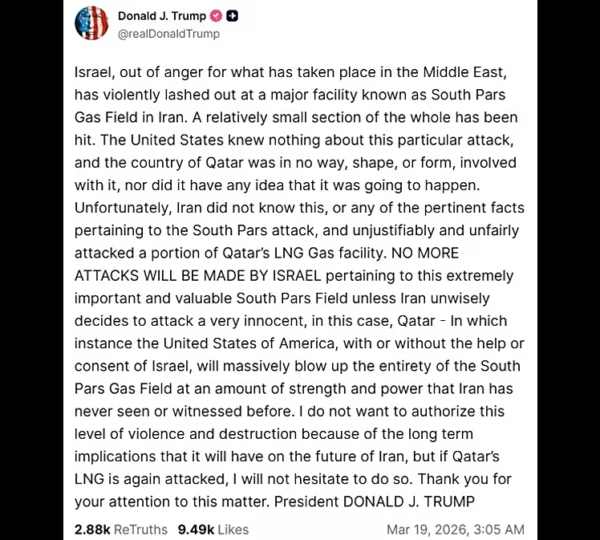
One message in particular sparked alarm: Trump appeared to suggest that Israel acted independently in the South Pars attack and issued a severe warning about future retaliation, drawing widespread online criticism.
In his post, Trump distanced the United States from prior strikes, claiming it had “zero involvement” in the attack — a statement that Israeli officials privately disputed, saying Washington was informed in advance.
He then wrote that if Iran were to attack Qatar again, the United States “will massively blow up the entirety” of the South Pars gas field with unprecedented force, raising concern among critics and foreign observers.
South Pars is shared between Iran and Qatar’s North Field, meaning damage there could not only devastate Iranian energy production but also significantly affect global gas supplies and energy markets.
Criticism of Trump’s message was swift online, with critics arguing that such rhetoric could further destabilize an already volatile region and risk inadvertent escalation among nuclear‑armed states.
One widely shared reaction on social media framed the statement as dangerously impulsive and a sign of lost control, even calling for constitutional remedies to prevent further escalation.
Other commentators questioned Trump’s grasp of the conflict, arguing that non‑experts with significant destructive power should exercise caution and prioritize diplomatic channels over threatening statements.
Analysts noted that such public, bold rhetoric in the midst of active military conflict can impact energy markets, foreign relations, and military coordination, further complicating efforts to deescalate tensions.
Hours after the controversial post, Israeli Prime Minister Benjamin Netanyahu reportedly agreed to delay further strikes on Iranian energy facilities, allegedly at Trump’s urging, signaling some degree of coordination despite rhetoric.